
Child Support Mistakes Costing You Thousands: 10 Reasons Your Ontario Payment Calculation Isn't Working (And How to Fix It)

WE FIX CHILD SUPPORT CALCULATIONS FOR BRAMPTON & ORANGEVILLE PARENTS
Clear Payment Review & Practical Next Steps — Call 905-497-7200
Child support in Ontario looks like a simple table.
Put in income.
Get a number.
Done.
That is the trap.
In real files, the “number” breaks because the inputs are wrong.
Or the legal category is wrong.
Or the parenting-time math is wrong.
Or extra expenses were never added.
In Brampton & Orangeville, this comes up constantly.
Support gets set during separation stress.
Then life changes.
Jobs change.
Schedules change.
Kids’ needs change.
The payments do not change with it.
This article covers 10 mistakes that can cost thousands.
Each section includes what usually goes wrong.
Each section includes what fixes it.
1) Using Line 15000 incorrectly
Most Ontario child support calculations start with Line 15000 (Total income).
That is usually the right starting point.
Many people still misuse it.
Common errors in Brampton & Orangeville:
Using a paystub “gross” instead of Line 15000.
Using net pay after deductions.
Using a partial year because separation happened mid-year.
Ignoring bonuses, commissions, overtime patterns, or investment income.
Using last year’s number even though income has already changed.
Line 15000 is not always the final answer.
Some incomes need adjustments.
Self-employment income can need add-backs.
Business owner income can need a deeper look.
Fix: lock down the correct base income first.
Use Notices of Assessment.
Use full-year documents.
Use a consistent approach for variable pay.
Documents that help: last 3 years’ tax returns, Notices of Assessment, T4s, most recent paystubs, bonus/commission letters.
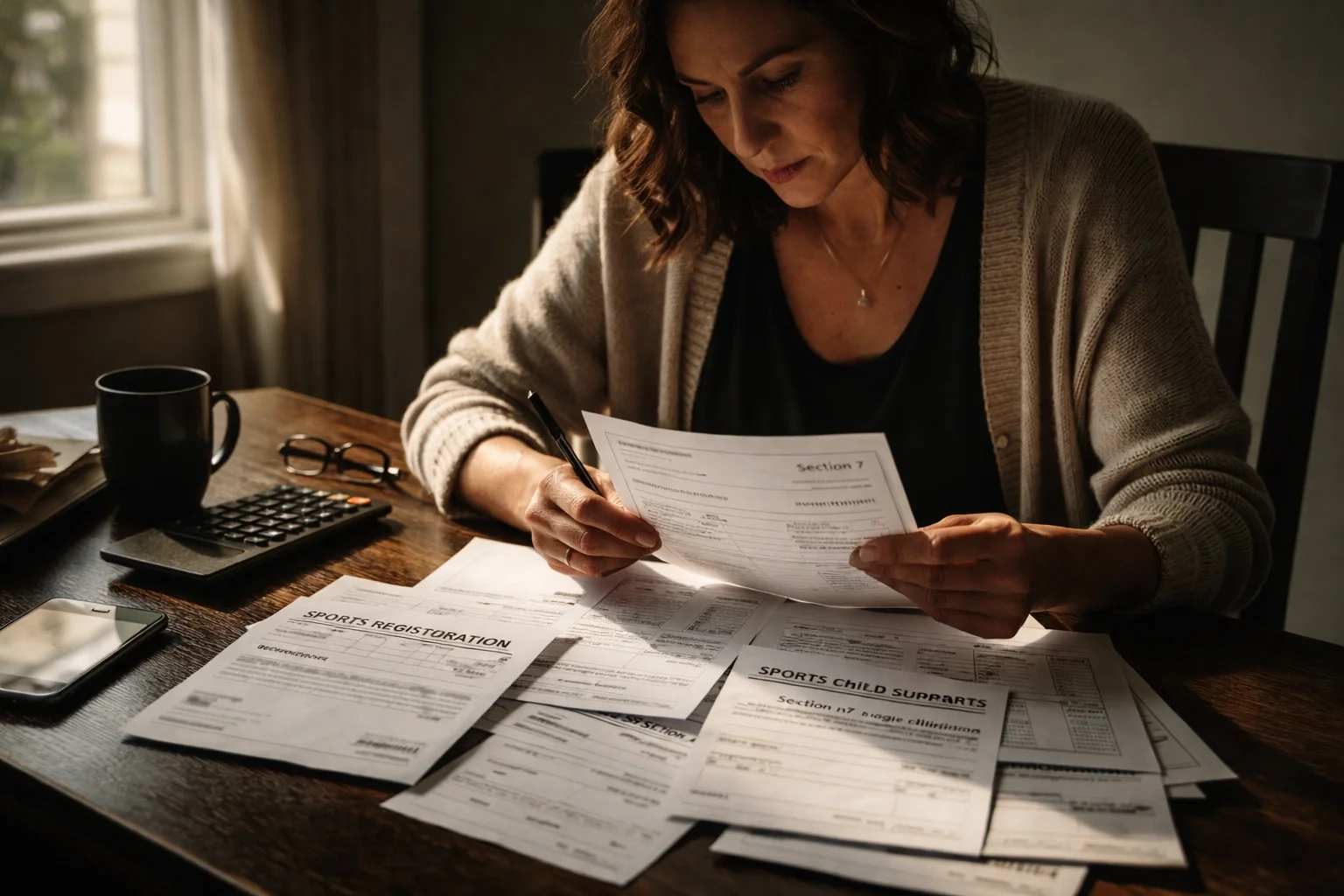
2) Missing Section 7 expenses (special & extraordinary)
Table child support is one layer.
Section 7 is the next layer.
Section 7 expenses often include:
daycare needed for work or school
medical & dental not covered by insurance
orthodontics (braces)
therapy, counselling, tutoring
extraordinary extracurriculars (certain sports fees, equipment, travel)
This is where Brampton & Orangeville parents get burned.
One parent pays.
The other refuses.
Or both assume the table amount already covers it.
Section 7 is usually shared in proportion to incomes.
Not automatically 50/50.
Not “whoever has the invoice wins.”
Not “no receipts required.”
Fix: identify the expense category.
Confirm it is necessary & reasonable.
Confirm the net cost after insurance or tax treatment.
Then split it proportionately.
Documents that help: receipts, invoices, insurance statements, proof of payment, childcare contracts, emails/texts showing notice or agreement.
3) The 40% Shared Custody Rule
Parenting time changes the entire framework.
The 40% rule is the line that gets missed.
If each parent has the child at least 40% of the time, shared parenting applies.
Support can shift to a set-off approach.
It can also include adjustments based on actual costs in each home.
Calculations fail when:
schedules are informal
time is guessed
overnights are counted wrong
holidays & PD days are ignored
a parent counts “available time” instead of actual time
In some Brampton files, criminal charges or conditions also change access.
No-contact orders.
Police involvement.
Supervised access.
Those facts can change the real parenting-time percentage.
Fix: count time carefully.
Use a calendar.
Use actual time patterns.
Then apply the correct guideline approach.
Documents that help: parenting schedule, calendar logs, school pick-up records, communications, any court orders or conditions that impact time.
4) Annual Income Updates
Support numbers go stale fast.
Ontario support should track income.
Many agreements & orders require annual disclosure.
The common pattern:
income rises
support stays low
arrears get claimed later
Or:
income drops
support stays high
overpayments create resentment
Annual updates reduce conflict.
They also reduce litigation.
Fix: set a yearly disclosure date.
Exchange tax returns & Notices of Assessment.
Recalculate.
Confirm in writing.
Documents that help: prior agreement/order, last disclosure exchange, last recalculation date, current income proof.
5) Imputed Income
Some parents report income that does not match capacity.
Ontario courts can impute income when facts support it.
Common scenarios:
working below ability with no good reason
quitting a job during separation conflict
choosing part-time without justification
cash income that never shows up on Line 15000
refusing reasonable job options
Imputed income is not a moral judgment.
It is a legal tool.
It is evidence-based.
It can dramatically change child support.
Fix: build a clear record.
Show earning history.
Show qualifications.
Show available work.
If health limits work, show medical evidence.
Documents that help: resume, job history, pay history, training/education, job postings, medical notes (if applicable).

6) Corporate Income (business owners)
Business owner support is rarely a “plug-in” number.
Line 15000 can be misleading for incorporated parents.
Why?
personal expenses may run through the corporation
income may be kept inside the company
shareholder benefits may exist
pre-tax corporate cashflow may not show personally
This is common in Brampton & Orangeville small business files.
Trades.
Trucking.
Construction.
Home services.
Professional corporations.
A basic calculator misses this.
It often understates support.
It can also trigger major disputes about disclosure.
Fix: analyse business income properly.
Review corporate financials.
Look for add-backs.
Look for shareholder benefits.
Look at consistency across years.
Documents that help: corporate financial statements, T2 returns, general ledger, expense categories, shareholder loan accounts, management compensation details.
7) Tax Credits & government benefits
Tax credits & benefits do not replace child support.
They do affect the real household picture.
In Brampton & Orangeville, common points of confusion:
Canada Child Benefit (CCB) changes with parenting arrangements
childcare deductions affect net costs of daycare
medical expense credits affect net medical costs
eligible dependant claims come up in negotiations
These details also matter in settlement talks.
They shift the real cashflow.
They change what feels “fair.”
They can also expose misinformation fast.
Fix: confirm who receives what.
Confirm what the CRA recognizes for the parenting arrangement.
Confirm net cost after deductions/credits where relevant.
Documents that help: CRA benefit statements, tax returns, childcare receipts, proof of the parenting arrangement reported to CRA.
8) Adult children in post-secondary
Support does not always end at 18.
Post-secondary often extends support.
The structure changes.
Key factors:
child lives at home or away
tuition, books, residence, meal plan
OSAP, scholarships, bursaries
the child’s part-time income
RESP withdrawals
Some parents assume full table support continues unchanged.
Some parents assume support ends automatically.
Both assumptions create costly fights.
Fix: treat post-secondary as its own category.
Build a budget.
Allocate costs.
Confirm the child’s contributions.
Confirm what is reasonable.
Documents that help: proof of enrolment, tuition invoices, residence contracts, OSAP summaries, the child’s budget, RESP statements.
9) Outdated guidelines & table amounts
Tables change.
People keep old numbers.
Support calculations fail when:
old tables are used
the wrong province is selected
the wrong number of children is entered
an old worksheet is copied forward
Even a small table change can matter over time.
Months add up.
Years add up faster.
Fix: confirm current guideline tables.
Confirm the province.
Confirm the correct number of children.
Confirm the correct income year.
Documents that help: last calculation printout, date it was done, inputs used, current income documents.
10) Undue hardship
Undue hardship is not common.
It is also not imaginary.
It is often ignored completely.
Situations that sometimes trigger it:
unusually high access costs (long travel)
legal obligation to support other dependants
exceptional debts connected to the family breakdown
household standards of living comparison issues
This is not a quick argument.
It requires evidence.
It often requires a deeper financial comparison.
Fix: gather full household financial information.
Show why the situation is truly exceptional.
Show the standard of living comparison.
Documents that help: full budgets, debt statements, proof of dependants, travel receipts, household income documents.
Conclusion: Next steps for Brampton & Orangeville parents
Wrong child support numbers do damage.
Overpayments drain savings.
Underpayments create arrears.
Both create conflict.
Both can end in court.
OMNI LAW GROUP
WE CALCULATE SUPPORT, NEGOTIATE TERMS, & LITIGATE FAMILY LAW FILES
Fast Intake & Clear Options — Call 905-497-7200
WE review income properly.
WE handle Section 7 correctly.
WE assess shared parenting time under the 40% rule.
WE analyse corporate income for business owners.
WE prepare variations when income or schedules change.
Phone: 905-497-7200
Website: https://www.omnilawfirm.ca
Serving: Brampton & Orangeville