
Looking for Evidence? 10 Things to Know Before Using Secret Audio in Your Ontario Divorce Case
Secretly recording your spouse in Ontario is rarely the "smoking gun" you think it is. While technically legal under the Criminal Code, family courts presume these recordings are inadmissible unless they prove serious misconduct or a risk to a child’s safety.
At OMNI LAW GROUP, we see it often: a client walks into our North Park Drive office with a phone full of heated arguments, hoping to win their custody battle. But before you hit "record" during a discussion about assets or parenting time, you need to understand how judges at the Davis Courthouse in Brampton actually view this evidence.
Quick Facts: Secret Recordings in Ontario Family Court
Is it legal? Yes, recording a conversation you are part of is legal under s. 184 of the Criminal Code.
Is it admissible? No, not automatically. Courts generally exclude them to discourage "corrosive" litigation.
What is the risk? It can make you look like a high-conflict parent, potentially hurting your custody case.
What about AI? In 2026, courts are increasingly skeptical of digital audio due to deepfake technology.
WE PROVIDE COMPREHENSIVE LEGAL SOLUTIONS FOR HIGH-CONFLICT DIVORCE
Contact OMNI LAW GROUP at 905-497-7200
Monday to Friday | 9:00 AM – 5:00 PM
1. One-Party Consent Doesn’t Mean "Court-Ready"
While Section 184(2)(a) of the Criminal Code allows you to intercept a private communication if you are one of the participants, family law is different. In the case of Sordi v. Sordi, the Ontario Court of Appeal made it clear that there are "sound public policy" reasons to discourage these recordings. The court doesn't want families living in a "surveillance state" where every breakfast argument is taped for future litigation.
2. The Van Ruyven Test: The Presumption Against You
The modern leading case, Van Ruyven v. Van Ruyven (2021), changed the game. Now, Ontario courts must presume that the harm caused by secret recordings (prejudicial effect) outweighs their helpfulness (probative value). To get a recording admitted, you must prove one of three things:
There is serious misconduct by a parent.
There is a significant risk to a child’s safety.
It is essential to doing justice.
3. The Nine Reliability Concerns of Tillger
Even if you pass the initial test, the court will scrutinize the recording using the "Tillger Factors" from Tillger v. Tillger (2019). Judges are savvy, they know that a recording that starts halfway through a fight often misses the "recorder" provoking the other person.
The Tillger Reliability Checklist
1. Does the recording reflect the full context?
2. Is this typical behaviour or a one-off?
3. Is the person recording acting "for the camera"?
4. Has the audio been edited or clipped?
5. Is it a "cherry-picked" moment?
6. Does it show the full interaction?
7. Is it just an isolated incident?
8. Did the person recording provoke the reaction?
9. Was the entire scene staged?
4. Why "Partial Recordings" Often Backfire
We often see recordings where one spouse is yelling while the other remains eerily calm. In the Brampton Davis Courthouse, judges often see through this. If the audio starts right when your spouse loses their temper, the court may conclude you were the provocateur. As noted in Ali v. Obas (2022), poor quality or incomplete audio has "slight" value and is usually tossed out.
5. Can I Use Recordings to Prove Family Violence?
Sometimes, yes. In Auciello v. Auciello (2023), recordings were admitted because they directly related to the father’s interaction with the child and their "best interests." If you are working with a Family Lawyer in Brampton to prove a history of abuse, a recording might be your only objective evidence. However, it must be authenticated and used sparingly.

6. The Danger of "The Recording Trap"
In Kidd v. Mokrenko (2024), a mother recorded a father, expecting to show his aggression. Instead, the court found she was the one engaging in family violence by berating him while the "record" button was live. Using secret audio is a double-edged sword; it captures your behaviour just as clearly as your spouse’s.
7. Being "Obsessed with Evidence" is a Custody Killer
Justice Pazaratz, in the famous case K.M. v. J.R. (2022), warned about parents who become "so obsessed with gathering damaging evidence that they have lost track of the devastating consequences on the child." If the Peel Children’s Aid Society (CAS) or a judge sees you as a parent who prioritizes "catching" the other side over protecting the kids from conflict, your parenting time could be at risk.
8. Financial Costs of Secret Recordings
Even if a recording helps your case, it could cost you money. In Kralka v. Courtis (2024), the court's disapproval of covert recording conduct resulted in neither party being awarded legal costs, despite one side "winning" on the issues. Judges use cost awards to punish what they see as "underhanded" litigation tactics.
9. Deepfakes and AI in 2026: The New Reality
As we move through 2026, the rise of AI-generated audio is a massive concern in Ontario courts. Law360 Canada has highlighted that digital authentication is now mandatory. If you present a recording, be prepared for a Criminal Defence Lawyer in Orangeville to challenge its authenticity. Courts now frequently require the original file and metadata to ensure no "deepfake" or AI modification has occurred.
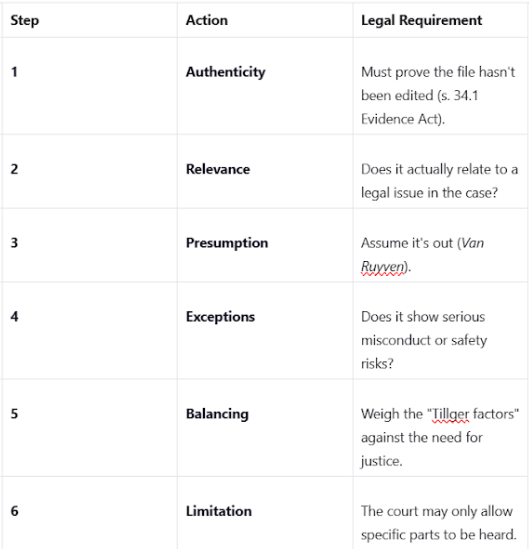
10. The 2026 Admissibility Test
If you are planning to use a recording at the Orangeville Courthouse or the Davis Courthouse, your legal team must follow this strict step-by-step process. If your case involves family law issues in Orangeville, working with an Orangeville Family Lawyer can help frame the evidence properly. If criminal law concerns are also in play, the strategy must account for both courts and both risks.
How do I file for divorce at the Davis Courthouse in Brampton?
To file for divorce in Brampton, you must submit an Application (Form 8) at the Davis Courthouse located at 7755 Hurontario Street. Our office on North Park Drive is just a short drive away, making it easy for us to handle the local logistics, including navigating the long security lines at the courthouse. We focus on the intersection of Criminal Defence and Family Law, ensuring that if your divorce involves domestic allegations or police involvement, your rights are protected on both fronts.
Will the judge look at my secret recordings?
It is unlikely. Unless the recording proves a serious safety threat or criminal conduct, most judges will find that the "corrosiveness" of secretly recording your spouse outweighs the value of the evidence. In 2026, cases like X.L. v. Z.L. continue to show that courts prefer testimony and documented evidence over surreptitious audio. If you recorded a "heated exchange" about assets, it is almost certain to be excluded.
Can I be charged with a crime for recording my ex-spouse?
If you are part of the conversation, you are generally safe from criminal charges under s. 184 of the Criminal Code. However, if you leave a recording device in a room where you are not present (like a bugged bedroom or car), you could face serious criminal charges for intercepting private communications. WE PROTECT CLIENTS FACING CRIMINAL CHARGES AND FAMILY LITIGATION. If you have been accused of illegal recording by the Peel Regional Police, you need immediate legal advice.
WE NAVIGATE COMPLEX FAMILY LAW MATTERS WITH PRECISION
OMNI LAW GROUP | 905-497-7200
ONE-STOP LEGAL SOLUTION FOR BRAMPTON & ORANGEVILLE
MONDAY TO FRIDAY: 9:00 AM – 5:00 PM
LOCAL LEGAL FAQ
How does the Brampton Davis Courthouse handle digital evidence like audio files?
The Davis Courthouse in Brampton has strict protocols for digital evidence. You cannot simply play a recording from your phone in the courtroom. You must provide a transcript, the original digital file (with metadata intact for 2026 authentication standards), and often a "voir dire" (a trial within a trial) is held specifically to decide if the audio is admissible. Our team handles these logistics daily, ensuring that if evidence is critical, it meets the high threshold required by Peel Region judges.
What happens if I recorded my spouse without their knowledge in Orangeville?
In the Orangeville Courthouse, as in Brampton, the Van Ruyven presumption applies. Judges in Dufferin County are particularly sensitive to how high-conflict behaviour affects children in smaller communities. If your recording was made in the presence of children or involves "coaching" them, it will likely be excluded, and you may face a stern rebuke from the bench regarding your parenting judgment. If you are searching for an Orangeville Family Lawyer, this is one of the most common family law issues we review alongside related criminal law risk. It is always better to consult with us before attempting to use such evidence.
Does OMNI LAW GROUP handle both the family and criminal aspects of secret recordings?
Yes. We are a one-stop legal solution. Because we handle both Criminal Defence and Family Law in Brampton, we understand the unique risks. A recording that you think helps your "simple divorce" could inadvertently provide evidence for a "domestic assault" charge. We look at your case through both lenses to ensure that your attempt to gather evidence doesn't lead to a criminal record or a loss of parenting time.
ABOUT THE AUTHOR

Rahul Kaushal is the Co-founder of OMNI LAW GROUP and an experienced lawyer called to the Bar of the Law Society of Ontario. Rahul focuses on navigating the complex intersection of Family Law and Criminal Defence for clients in Brampton, Orangeville, and the Greater Toronto Area. Alongside Co-founder Vaneet Sangha, Rahul has built OMNI LAW GROUP into a premier destination for individuals seeking practical, personalized, and authoritative legal solutions. Whether dealing with high-conflict custody disputes at the Davis Courthouse or defending complex criminal charges, Rahul is dedicated to protecting his clients' interests with integrity and efficiency.